Pothos Plant Varieties
Pothos plants are available in many leaf colors and patterns. Some have solid green leaves while others have white, yellow, cream or light-green markings.
Most common indoor pothos varieties belong to the species Epipremnum aureum. They have similar basic care needs but highly variegated types usually need brighter indirect light to maintain their leaf patterns.
Popular Pothos Varieties
| Variety | Leaf Appearance | Helpful Identification Feature |
|---|---|---|
| Golden Pothos | Green with yellow or gold markings | Irregular golden patterns |
| Marble Queen | Green and creamy white | Heavy marbled pattern |
| Neon Pothos | Bright yellow-green | Mostly one clear color |
| Jade Pothos | Solid dark green | No white or yellow pattern |
| N’Joy Pothos | Green with cream sections | Small leaves with clear edges |
| Pearls and Jade | Green, white and gray | Speckled white sections |
| Snow Queen | Mostly white with green | Very strong white variegation |
| Manjula Pothos | Green, cream and silver | Wide leaves with soft, mixed patterns |
These names and leaf features are recognized in horticultural references and commercial plant identification guides.
Golden Pothos
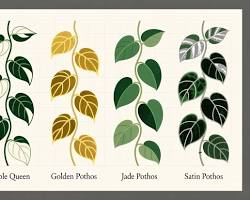
Golden pothos is the variety most people recognize. It has green, heart-shaped leaves with yellow or golden markings.
The amount of yellow can change with light. A plant in bright indirect light may show stronger coloring while one in low light may become greener.
Golden pothos is a practical choice for beginners because it adapts well to normal indoor conditions.
Marble Queen Pothos
Marble Queen pothos has green leaves covered with cream or white marbling. Each leaf can have a different pattern.
Because the white parts contain less green coloring Marble Queen may grow more slowly than a mostly green pothos. It should receive bright indirect light to help maintain its pattern.
Avoid strong direct sunlight because white areas can burn more easily.
Neon Pothos
Neon pothos has bright chartreuse or yellow-green leaves. New leaves may look especially bright, while older leaves can become slightly deeper in color.
It needs good indirect light to keep its fresh color. In a dark place, the leaves may become duller and greener.
Jade Pothos
Jade pothos has simple, solid green leaves without yellow or white markings.
It can be a useful option for rooms with slightly lower light because it does not depend on light to maintain white variegation. However, it will still grow better with suitable indirect daylight.
Its plain green color also makes leaf problems easier to notice.
N’Joy Pothos
N’Joy pothos usually has smaller green leaves with cream or white areas. The light sections often appear close to the leaf edges.
Its pattern looks cleaner and more separate than the mixed marbling seen on Marble Queen.
Give it bright indirect light and avoid keeping the soil wet for long periods.
Pearls and Jade Pothos
Pearls and Jade has small green leaves with white and gray markings. Its white sections often contain tiny green or silver speckles.
It usually grows more slowly than Golden Pothos. This makes it suitable for shelves and small indoor spaces where a very fast-growing vine is not needed.
Snow Queen Pothos
Snow Queen has a large amount of white or cream variegation mixed with green.
It is often confused with Marble Queen. Snow Queen usually appears whiter, while Marble Queen normally has a more balanced mix of green and cream.
Place it in bright indirect light. Very low light may lead to greener new growth.
Manjula Pothos
Manjula has wide, heart-shaped leaves with cream, green, silver and light-green patterns. The edges can look slightly wavy.
Unlike N’Joy its colors often blend together without a sharp border. Every leaf may look different.
Caring for Variegated Pothos
White and cream leaf sections cannot use light in the same way as green sections. For this reason, a highly variegated plant may grow more slowly.
Give variegated varieties good indirect light but do not place them under harsh direct sunlight. Prune vines that produce only weak or damaged leaves.
Do not add extra fertilizer only because a variety grows slowly. Its natural leaf pattern may be the reason for slower growth.
Final Thoughts
Pothos plant varieties may look different but their basic needs are similar. They prefer indirect light careful watering and soil that drains well.
Choose a variety based on the color you enjoy and the amount of light available in your room.